Wednesday, November 14, 2012

Are You Sure You Want a Playoff?


It’s that wonderful time. The time when, as college football fans, we pine for a different manner of resolving the debate of who is the nation’s best team. Arguments continue to abound on both sides, for a playoff (“Let the teams decide it on the field!”) and for the status quo or something like it (“College football has the most important regular season in all of sports!”). Let’s see what happens given our various systems.

First and foremost, because it is only mid-November, we have to make a lot of assumptions. For the purposes of this post, here it is in one sentence: every current conference leader wins out (including Notre Dame). Given that foundation, off we go!

Current System
The BCS is going to take a ton of heat if every team wins out. Oregon, the current BCS #2, is a lock for the championship game if they win out as their remaining games are v. #13 Stanford, at #16 Oregon State, and the Pac-12 Championship Game versus the winner of this Saturday’s tilt between USC and UCLA. But their opponent? Kansas State currently has a decent-sized lead over Notre Dame in the BCS standings – the Wildcats also lead Oregon for the time being – and have reasonably strong opponents Baylor and #15 Texas remaining. Blowout wins over West Virginia and Miami look much less impressive in light of their combined 10-9 record as well as the fact that Notre Dame also destroyed the Hurricanes. Still, Kansas State’s lead is solid enough that Notre Dame cannot expect to jump over either opponent unless one of them loses.

Result: The #1 v. #2 format yields a championship game of #1 Oregon v. #2 Kansas State. Somewhat paradoxically, the new Pac-12 Championship Game – added to provide the Pac-12 champion with an end-of-season boost in the rankings – makes Oregon’s trip to the National Championship Game that much tougher. Oregon allowed 34 points to Arkansas State…but only after racing out to a 50-3 lead with 7 minutes remaining in the second quarter. Outside of the Red Wolves, USC scored twice as many points as any Oregon opponent (51). The clash in Los Angeles was also the only Ducks game decided by fewer than three scores. I’m certain that Pac-12 Commissioner Larry Scott will still receive accolades for generating additional revenue for his member schools. But if the additional game is the difference between a National Championship for the Ducks and a Rose Bowl blowout of Nebraska, Scott will have some critics.

2014 System
Beginning in 2014, four teams will be selected by a committee to participate in a playoff. The teams will meet in two of six current bowl games (Rose, Fiesta, Cotton, Sugar, Chick-fil-A, Orange), then the winners of the two semifinals will meet to decide the champion.

Result: Undefeated Oregon, Kansas State, and Notre Dame are locks. If all of the leaders win out as assumed, Alabama is a lock for the fourth spot. Thus, we have #1 Oregon v. #4 Alabama and #2 Kansas State v. #3 Notre Dame followed by the winners squaring off in the championship game. This system looks fine and dandy for the time being. But if our assumption doesn’t hold – namely, one of the three undefeated teams loses a game – chaos ensues. Alabama has a strong case to be the cream of the one-loss crop. But if any of the other teams lose, does their spot go to Georgia or Florida? Possibly. Yet again, the conference championship game could prove detrimental for the qualifying team. It’s not too hard to imagine a scenario where Georgia wins the SEC East at 11-1, then falls to Alabama in the SEC Championship Game, paving the way for 11-1 Florida to reach the National Semifinals. In some regard, that was decided on the field: Georgia had a chance to play their way into the semifinals but lost to Alabama. On the other hand, Florida gets the conference championship game loser’s spot by staying at home, having failed to qualify for the game by virtue of an earlier loss.

This system is much more forgiving to Oregon (and Larry Scott). Should the Ducks fall to the USC-UCLA winner in the Pac-12 Championship Game, they would still have a chance to qualify for one of the four semifinal spots as opposed to being locked out under the current format.

16-Team Playoff (Option 1)
There are a number of proposals for intermediate-sized playoffs, normally eight and 12 team formats. But the one currently making the rounds in my circles is a 16-team format that awards a playoff spot to the champions of all 11 FBS conferences and to five at-large teams. Let’s take a look at what that would mean this year if all of the conference leaders held serve the rest of the way.

Conference Champions: Florida State (ACC), Kansas State (Big 12), Rutgers (Big East), Nebraska (Big Ten), Central Florida (C-USA), Northern Illinois (MAC), San Diego State (Mountain West), Oregon (Pac-12), Alabama (SEC), Arkansas State (Sun Belt), and Louisiana Tech (WAC).
At-Large Qualifiers: Notre Dame (Ind.), Florida (SEC), Clemson (ACC), LSU (SEC), Texas A&M (SEC)

*Note that by assuming wins for current leaders, Georgia will be 11-2 with a loss to Alabama. Similarly, Stanford will record their third loss versus Oregon.

There would be plenty of issues to work through given this format. Are games played at home or at neutral sites? Are conference winners given priority in seeding or are the teams seeded exclusively by a selection committee? And will teams knocked out early in the playoff still have the opportunity to participate in bowl games? I assume that the first (and probably second) rounds would occur as home-road games, yielding something like this:

(1) Oregon v. (16) Arkansas State
(2) Kansas State v. (15) Northern Illinois
(3) Notre Dame v. (14) Central Florida
(4) Alabama v. (13) San Diego State
(5) Florida v. (12) Rutgers
(6) Texas A&M v. (11) Louisiana Tech
(7) Florida State v. (10) Nebraska
(8) LSU v. (9) Clemson

Result: I’m sure Oregon fans are dying for the Ducks-Red Wolves rematch. In all seriousness, there appear to be three really interesting contests, two likely horrendous ones, and a trio that aren't all that interesting in the middle. Obviously this regime gets a whole lot more interesting in round two and earns some fairness points for giving every conference a seat at the table. But really, Oregon v. Arkansas State?

16-Team Playoff (Option 2)
The amended regime is much more appealing in my view. The five power conferences get a guaranteed berth (SEC, Pac-12, Big 12, Big Ten, ACC), the three highest ranked teams from non-power conferences - using a BCS-like formula - get guaranteed spots, then the remaining eight spots are open to at-large teams. The SEC would love this. It would be interesting to see if Notrde Dame could hook in through the ACC spot. I'd love to be in on those conversations. Here's who makes it:

(1) Oregon v. (16) San Diego State
(2) Kansas State v. (15) Rutgers
(3) Notre Dame v. (14) Michigan (or USC if they beat UCLA and play Oregon closely again)
(4) Alabama v. (13) Louisiana Tech
(5) Florida v. (12) Nebraska
(6) Texas A&M v. (11) Oklahoma
(7) Florida State v. (10) South Carolina
(8) LSU v. (9) Clemson

Result: Our best looking bracket yet. Some smaller schools get their chance to play Cinderella. And while they're obviously in worse shape than they would be in the previous option, it's a whole lot better than the status quo. Plus, the reward for being in the top one or two is enormous: while Notre Dame has a rematch with pesky Michigan, Oregon gets a relative cakewalk versus San Diego State. I can really sink my teeth into this option.

Final Thoughts
The last option strikes me as the best playoff option, although it does seriously bring the bowl system into question. With that said, I'm in a unique position: I absolutely love the NFL - specifically the Bears - but am only a big fan of college football. Because of the primacy of the NFL in my mind, I don't terribly mind the controversy that surrounds the end of every college football season. It gives me something else to follow. Had Penn State not lost to Michigan in 2005, run the table, and still been edged out of the title game in favor of Texas and Reggie Bush's Illicit Payments, maybe I'd be singing a different tune. As it is, give me all or nothing (16 or four). Don't give me four teams.

Monday, November 12, 2012

Bears-Texans Thoughts

That was a brutal game. It was a really difficult game to watch as a Bears fan. Jay Cutler's injury was certainly the worst individual moment of the game. But the overall feeling of the game made it so much worse than just a big injury to the team's most important player.

The Texans realized Cutler wasn't going to play in the second half and punted their offense. They didn't even try. That's the worst part.

On to the thoughts:

1. Houston's second half drives were pathetic.... Here are the possessions:

#1: Starting at HOU 3. Incomplete pass, -1 yd run, 4 yd run, punt
#2: Starting at HOU 16. 1 yd run, incomplete pass, 7 yd pass, punt
#3: Starting at HOU 11. -2 yd run, 23 yd pass, 7 yd run, -1 yd run, -7 sack, punt
#4: Starting at HOU 38. 3 yd pass, incomplete pass, incomplete pass, punt
#5: Starting at HOU 47. 5 yd run, 7 yd run (plus a 15 yd facemask penalty), -1 yd run, (10 yd holding penalty), 2 yd pass, 11 yd pass, FG
#6: -3 yd run, 0 yd run, 1 yd run, punt
#7: Kneel downs

I won't include the seventh drive for obvious reasons. Not including the five punts and the field goal, Houston amassed the following totals among their drives: 12 running play calls, 10 passing play calls, 17 rushing yards, 39 passing yards. They just couldn't do anything against the Bears defense. If I was a Texans fan, I would be happy with a victory in a tough environment, but I wouldn't feel great about my team's performance. Except for Danieal Manning. He had put things together by his last year in Chicago, and by all accounts he has continued to thrive for Wade Phillips.

2. ...But the Chicago offense has no chance of thriving without Jay Cutler. A look at every Bears possession, with Cutler at the helm for every first half possession and Jason Campbell leading the way for the second half:

#1: Starting at CHI 45. 6 yd pass (fumbled)
#2: Starting at CHI 37. 2 yd run, 9 yd pass, 2 yd run, 7 yd scramble, 0 yd pass, 11 yd run (fumbled)
#3: Starting at HOU 45. 14 yd pass, 1 yd run, interception
#4: Starting at HOU 33. 4 yd run, 1 yd run, incomplete pass, FG
#5: Starting at CHI 20. Incomplete pass, 7 yd pass, incomplete pass, punt
#6: Starting at CHI 49. 2 yd run, -1 yd run, 11 yd scramble, 0 yd pass, interception
#7: Starting at CHI 21. 19 yd scramble, incomplete pass, incomplete pass, 4 yd pass

The first half totals are ugly: 8 running play calls, 17 passing play calls, 59 rushing yards, 34 passing yards, four turnovers.

The most painful plays are littered throughout the first half. Kellen Davis's fumble on the first Bears play showed a tremendous lack of awareness by Davis. Michael Bush's fumble on a big fourth-and-one conversion was especially saddening. And Brandon Marshall's inability to hold on to Cutler's beautiful pass on the fourth drive was frustrating.

The second half was much more frustrating largely because the score remained so tight but the offense couldn't muster scoring drives. The possessions:

#1: Starting at CHI 23. 7 yd run, 8 yd run, 1 yd run, 2 yd pass, 18 yd pass, 0 yd run, 0 yd pass, 4 yd pass, punt
#2: Starting at CHI 38. 1 yd run, incomplete pass, 5 yd scramble, punt
#3: Starting at CHI 48. 2 yd run, (false start), 45 yd pass, 5 yd run, -1 yd run, incomplete pass, FG
#4: Starting at CHI 38. 9 yd pass, 20 yd run, 3 yd run, incomplete pass, incomplete pass, missed FG
#5: Starting at CHI 14. 5 yd run, (holding penalty), 5 yd pass, incomplete pass, punt
#6: Starting at CHI 25. Incomplete pass, -1 yd pass, incomplete pass, punt
#7: Starting at CHI 38. -3 yd pass, (holding penalty), 7 yd pass, 8 yd pass, incomplete pass

Obviously it wasn't pretty. That's 11 running plays, 20 passing plays, 56 rushing yards, and 94 passing yards.  For the game, the Bears totaled 19 running play calls, 37 passing play calls, 115 rushing yards, and 128 passing yards.

I think it's unfair to say that Matt Forte didn't get into a groove. Similarly, I think it would be wrong to say that either quarterback failed to establish a rhythm. No offensive player really had the opportunity to do so.

What's most alarming to me is that of their 14 possessions, the Bears offense started beyond their own 35 nine times. Nine. Five of those drives began within 55 yards of the Houston endzone. Yet they only managed three field goal attempts. Given that level of ineptitude, there's plenty of blame to go around. It was a really poor effort by the offense.

3. Kellen Davis will be looking for a new uniform this spring. I often think about what the team needs to do going forward, looking to the upcoming draft to determine what needs are most pressing. This year, I have largely settled on my views. A defensive tackle needs to be added if Henry Melton leaves in free agency. A middle linebacker needs to be brought in (see more on that below). Offensive line help is an obvious need. But tight end tops the list. That's not to say bringing in an elite talent at the position should trump other needs; it is to say that bringing in new talent at the position to complement Evan Rodriguez and Matt Spaeth is of the utmost importance.

Davis has been maddeningly inconsistent as a Bear. He has made some excellent catches, using his athleticism to block out defenders. He has countered those contributions by occassionally missing key blocks and regularly dropping catchable passes, frequently as the check down option on third down, a complication that makes the drops particularly devastating.

Against the Texans, Davis had three costly errors. First, the aforementioned fumble on the game's opening play. Additionally, he dropped a roughly 10 yard pass from Cutler on Chicago's final drive of the first half that would have given the offense the ball at midfield with approximately 20 seconds. Finally, on the Bears' penultimate drive of the game, Campbell threw his second best pass of the night (the best being his beautiful heave down the left sideline to Marshall) putting a skinny post right on Kellen's hands. Because of the drop, the Bears punted instead of continuing the drive near the 50. While it would have been a nice catch, it's the kind of play that Davis needs to make in order to keep his job in the NFL.

The guess here is that the Bears front office has seen enough of Davis to let him walk as a free agent. I imagine a middle round draft choice will be used on his replacement.

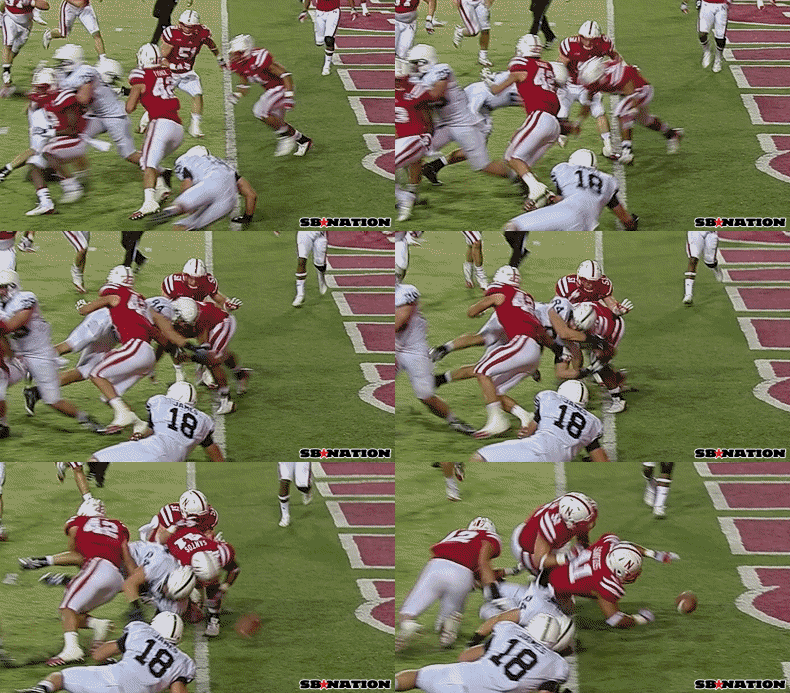
4. The officials, man, the officials. In the interest of full disclosure, I am a Penn State fan. That means that I entered Sunday with a poor taste in my mouth when it comes to video reviews thanks to this being ruled a fumble. Even though I was predisposed to be frustrated by the video reviews in tonight's game, I think I'm justified in being unhappy. As I recall, there were four reviews:

#1: The opening kickoff. On the field, Keshawn Martin was deemed to have fumbled. He clearly didn't and a quick review corrected the error. One for one.
#2: Tim Jennings' interception return. It's not terribly clear what was called on the field. Gene Steratore stated that the play was blown dead by a whistle when Jennings was at the 30. After review, he said that the video clearly showed that Jennings was touched down at the 38. To me, it looked like Jennings probably made contact with a Texan, but I don't think any video showed that incontrovertibly. There was much clearer evidence that Matt Lehman crossed the goal line in possession of the football in the above clip. More importantly here, had Jennings not been ruled down, I believe that the video would have showed Jennings reaching the 10 or even possibly the endzone prior to a whistle being blown. I think the refs missed this one.
#3: Arian Foster's touchdown catch. They wisely called it a catch on the field and this was upheld after a quick review. It was a fantastic grab by Foster on a tough play.
#4: Jay Cutler being over the line on a 45 yard pass to Devin Hester. The officials said that Cutler was over the line on the field and after review Steratore said that video confirmed the call. I'm hoping he meant to say that the ruling on the field stands, not that it was confirmed. With the benefit of a nifty red line, NBC showed that Cutler's back foot was behind the line when he threw the pass. So instead of the referee overturning the call on the field as the video showed - resulting in a first and goal at the Houston 3 - the call on the field stood, resulting in a replayed third-and-11 at midfield.

Had either video review gone in the Bears' favor, they stood an excellent chance at scoring an elusive touchdown.

Beyond the video reviews, I don't have much beyond the generic fan complaint about the officiating. I thought that there was an absurd amount of contact with Matt Forte on the last Bears play, but the nature of fourth down in the fourth quarter is that pass interference will be especially hard to come by.

5. Brian Urlacher makes me happy and sad. Urlacher makes me happy for the obvious reason that he's still miraculously playing professional football at 34 and coming off a knee sprain. He makes me happy because he still leads the defense in many respects. He makes me happy because he has been the face of Bears football for a decade and done the team proud.

But he makes me sad too for one terrible reason: he's rapidly approaching the end of the line. Urlacher is smart enough that he can continue to play at a reasonable level even as his body fades. There have already been an uncharacteristic number of plays this season where Urlacher read the play correctly but simply wasn't fast or quick enough to make the stop. Tonight, a different problem emerged. On a third-and-19 from the Chicago 35, Matt Schaub dropped off a pass to reserve tight end Garrett Graham. Urlacher had Graham sized up, hit him and had his arms wrapped around the receiver; Urlacher couldn't bring him down. Graham squirted away for about five extra yards, turning a 47 yard field goal attempt into a stiff wind into a 42 yard try that ultimately cleared the crossbar by only a few yards.

Urlacher can survive in the NFL for a few more years given his pedigree and knowledge. But if he only wants to stay in the league as the Chicago Bears starting middle linebacker, the team and its signature player could very well be headed for an ugly off-season.

6. The Bears are still fine. Before the season, I picked the Bears for the first NFC wild card spot with an 11-5 record. Admittedly I thought they would lose in Dallas but squeak past Houston at home. Nonetheless, I had them at 7-2 heading into their Monday Night Football clash in San Francisco. I have no idea what to expect from a Colin Kaepernick-Jason Campbell matchup next week. But I still feel confident that the Bears can find four - and certainly three - more wins the rest of the way. Trips to San Francisco, Minnesota, Arizona, and Detroit should net between one and two wins while home dates versus Minnesota, Seattle, and Green Bay should result in two wins.

Obviously an extended absence for Jay Cutler could change my thoughts here. However, even with Campbell at the helm, the Bears boast a strong run blocking offensive line, a pair of good backs, a great defense, and generally strong special teams. I would be absolutely stunned if those features cannot combine for at least a 3-4 record the rest of the way, even with the ramped up schedule. My main concern is that an extra loss the rest of the way could mean the difference between a first round bye and a wild card weekend trip to New Jersey, San Francisco, or even, gulp, Green Bay. Let's just run the table and avoid that.

Saturday, November 3, 2012

Alabama-LSU

I'm not even attempting analysis here. I just want to get this on the record before this game really gets underway (we're about a minute and a half deep).

Alabama plays different football from everyone else.

Tide 33, LSU 13

Thursday, November 1, 2012

James Harden

I'll likely take a look at the recent extensions signed by fourth-year NBA players in the coming weeks. But there's one thing that requires immediate attention. I would have posted earlier on this topic, but I got caught on the wrong side of Hurricane Sandy, so I spent a few days off the grid.

Anyway, in case you have also been on the wrong side of the storm, the Thunder and Rockets pulled off a doozy of a deal on Saturday.

Houston Gets:
SG James Harden
C   Cole Aldrich
SF Lazar Haywood
SG Daequan Cook

Oklahoma City Gets: 
SG Kevin Martin
SG Jeremy Lamb
2013 first-round pick (from Toronto - doubly protected. 15-30 protected 2013-17; top-3 protected 2013, top-2 protected 2014-15, top-1 protected 2016-17)
2013 first-round pick (from Dallas - top-20 protected through 2017)
2013 second-round pick (from Charlotte)

Aldrich, Haywood, and Cook are largely fill-ins to make the trade work under the salary cap. We can dispose of their impact on the deal quickly. Cook is something of a three-point specialist who struggled with three-pointers last year. Haywood is probably a fringe-NBA player. And Aldrich has averaged just seven minutes per game for his career. None of the three should have much of an impact on Houston this year or going forward.

So this basically breaks down to a deal of Harden for Martin, Lamb, and two top picks. Let's look at Oklahoma City's haul first, in reverse order.

That pick from Dallas could be a long time coming. Dirk Nowitzki is out indefinitely after undergoing knee surgery two weeks ago. The Mavericks have enough talent to squeak into the playoffs, but their combination of over-the-hill veterans (Vince Carter, Elton Brand, Shawn Marion, Eddy Curry) and imperfect in-their-prime players (Darren Collison, Brandon Wright, O.J. Mayo) means they won't be picking outside of the top 20 until a new nucleus forms around a new star. Needless to say, that pick won't bring any returns to the Thunder anytime soon.

The Toronto pick is different. The protections require it to be a lottery pick but outside of the top few selections. It seems like there's a very good chance that the pick gets conveyed this year. Toronto has a below-average roster, but they shouldn't be picking in the top three this year unless they have a couple of serious injuries. Oklahoma City can expect to receive the mid-to-late lottery pick this year. Unfortunately for OKC, mid-to-late lottery picks tend not to become serious impact players. For example, the players drafted after James Harden in the 2009 draft: SG Tyreke Evans, PG Ricky Rubio, PG Jonny Flynn, PG Stephen Curry, PF Jordan Hill, SG DeMar DeRozan, PG Brandon Jennings, SG Terrence Williams, SG Gerald Henderson, PF Tyler Hansbrough, and SF Earl Clark. Only Rubio can truly be thought of as a player with impact potential at this point. Of the others, there are some nice complimentary pieces, but only Curry and Jennings are anything more. Simply put, it's highly unlikely that this pick becomes an elite player, although OKC has a good chance of finding a strong fourth banana or capable third banana.

Jeremy Lamb is a difficult player to peg. He should be a really great fit in the Thunder offense as more of a pure shooter than a slasher. While he is still plenty raw, he could be an excellent shooter within a couple of years. Elite shooting is a great skill; Kyle Korver has carved out a nice career for himself as a spot-up shooter with little other NBA-level skill. But Lamb's ceiling is much higher than Korver. Should he develop the ability to create his own shot, Lamb can be a really great addition. His ceiling is a solid tier below Harden's current status, however, and he is years away from it.

Which brings us to Kevin Martin. Martin is an obvious of a one year rental player as you'll find in a trade. Martin is set to earn a hair under $13M this year and become a free agent this off-season. He is a nice scorer who should mesh well with Durant and Westbrook in much the same way that Lamb may in the future. He is a tremendous free throw shooter who does a nice job getting himself to the line. His deep shooting has regressed in recent years, but he's hardly a poor shooter. Martin has been miscast as a primary scorer in recent years. He should have more success as a third option, although he is also a tier or so below Harden.

As for the centerpiece of the deal, James Harden is a stud. I didn't understand him from the moment I heard about him as a high draft pick through the middle of the 2010-11 season. It seemed like James Harden was going to be known as the guy the Thunder drafted instead of Steph Curry. But The Beard quickly changed my mind. He is a wonderfully creative scorer. He sees the court well and passes, at times, like a strong point guard. Harden shoots three-pointers as well as Kevin Martin. Harden's ability to create his own quality shot is among the top 15 or so players in the league. That's extremely valuable.

Harden's contract seriously complicated the situation. From what I can tell, Harden was willing to accept a "max" contract offer from the Thunder to remain their third option. According to the new collective bargaining agreement, teams are only allowed to have two players with five-year maximum deals. In the case of OKC, Kevin Durant and Russell Westbrook already posses those contracts, leaving Harden with a four-year max. However, as a result of the trade, Harden was eligible for (and has already signed) a five-year, $80M deal, the full "max" offer.

Evaluating the Trade
We've looked at all the assets that changed hands. So who won? Normally, it takes years to figure out the answer to this question. It could still happen here, especially if something funny happens with the Toronto pick (like the Raptors holding the pick this year, then sending #3 overall to OKC next year).

But this case is clear: it's a decent win for Houston and an enormous loss for Oklahoma City.

Houston has been gunning for an elite player for years. Harden is absolutely an elite player. They immediately wrapped him up for the next half decade. The Rockets are going to have a hard time putting together a championship roster around Harden. By virtue of a pair of poison pill contracts this off-season, the 2014-15 salary cap is going to be really difficult for Houston to manage. Still, there's no doubting they got significantly better in the last six months. Last year's team was centered on Martin, surrounding by solid role players at every other spot: Sam Dalembert, Luis Scola, Chandler Parsons, and Goran Dragic. They have since replaced Dragic with Jeremy Lin and Dalembert with Omer Asik, a pair of high-ceiling yet risky talents. It's not a great group, but Harden and Lin should create an exciting back court with Asik a nice compliment in the middle. Houston should be headed for some playoff trips, albeit as a lower seeded team.

But OKC. Man. In one regard, they were in a tough spot with lots of extension-ready talent and only so much cap space to spare. They wisely locked up both Durant and Westbrook. They also have Thabo Sefolosha and Nick Collison on solidly team-friendly deals. The two big players with big deals really complicated their cap situation. Kendrick Perkins is due $25.5M over the next three years (including this season). Serge Ibaka's deal, however, is the catch: beginning next year, Ibaka is due $49M over four years. His deal made it nearly impossible to retain Harden.

That sentence should alarm you. Serge Ibaka made retaining James Harden nearly impossible. Ibaka is a really good, valuable player. Harden is a top-20 NBA player. OKC could have flipped Ibaka for picks and had enough space to keep Harden with only minor moves possibly required.

OKC needed to find a way to stay ahead of the Nash-Bryant-Gasol-Howard Lakers and the Wade-James-Bosh Heat. OKC opted to go with only Durant-Westbrook and the hope that Jeremy Lamb grows into something vaguely like, well, James Harden.

Championship windows are inherently fickle. OKC may have just closed their own.

I understand that the Oklahoma City market isn't Los Angeles, New York, or Chicago. I also understand that Clay Bennett is worth roughly $400M. Bennett paid $45M to buy out two years of the team's remaining lease in Seattle. Winning helps to create cash flow. The Thunder already have at least $59M committed to player salaries in each of the next three years; it's not as if they won't be spending. They're trying to avoid paying a luxury tax and essentially given away shots at championships to do so. That's the definition of a terrible choice.

Obtaining an asset on the level of James Harden is difficult for any team to do once. It's effectively impossible for a team to do when that team already has players like Kevin Durant and Russell Westbrook. There is one big winner from the trade:

The 2012-13 NBA Champion Miami Heat

Saturday, October 27, 2012

College Football Polls: Why I Don't Care and Neither Should You

This could be a long-winded post about the stupidity of mid-season college football polls. There's an almost endless stream of absurdities one can levy on these evaluations. My favorite tend to be the following: there is absolutely no chance that the head coaches of NCAA Division I (FBS still sounds stupid) watch every other game played in a given week. For that matter, there is no chance that they watch more than a small handful of other games. Realistically, given the time demands of NCAA head coaches, they probably don't watch more than a couple of plays from other games in a given week with the exception of scouting video. Yet one third of the BCS formula is calculated using this poll. From what I understand, most coaches don't fill out their own version of the poll, instead signing off on the rankings of a staffer. That makes more sense than coaches making blind rankings, but it's hardly an ideal alternative.

As you can tell, I could go on for hours about this. Instead, I'm going to use one incredibly simple case study.

The Mississippi State Bulldogs.

In the interest of full disclosure, I'm a Dan Mullen fan. I think he's a really solid coach on his way to a more prestigious job. He had a strong showing at Florida, using a creative approach with uniquely talented players en route to two national championships. His work at MSU has been even more impressive, somehow parlaying sub-par talent into three straight winning seasons. Mullen deserves credit for his success.

But #11?

If the Bulldogs manage to be #11 at the end of the season, almost every non-Alabama school should consider immediately firing their coach and handing their program to Mullen.

To say that they're #11 right now really only furthers two purposes. First, it creates interest in games that otherwise wouldn't likely be that interesting when a squad gets a number next to their name. Second, it gives the media something to talk about.

I, for one, really dislike mid-season polls. If they were just a fun way to compare teams among fans, that would be fine. But they're much more than that. Polls are the main way that programs are measured against each other over time. So if a team can be ranked 24th to start the year and they schedule the dregs of Division I football to inflate their record early on, they might spend half of the season in the polls despite being a poor team. On the flip side, teams are severely punished for scheduling strong opponents early in the season. For example, Michigan started the year ranked 8th in both polls. Now, I thought they were listed about 10 spots too high, but pollsters obviously thought enough of the team to have them in the top 10. Then they were thoroughly handled by the nation's best team, Alabama...so they dropped 11 spots. Mid-season polls suggest that Michigan isn't nearly as strong as many expected. Reality gives us the course of the season to figure out how good a team is instead of trying to compare teams experiencing vastly different games week to week. Many pollsters are also unwilling to drop a team that wins. Thus, in the mind of some, a road win against a strong opponent is no more valuable than a home win against a weak one. That's absurd to me.

Back to Mississippi State. At this point in the season, it's hard to say they've done anything other than hold serve. They have played just two road games, a 30-24 win at Troy and a 27-14 victory at Kentucky. It's not bad to have beaten those teams; it just doesn't mean much. Kentucky is a putrid 1-7 while Troy's best win at 4-3 is probably against Alabama-Birmingham; plus, they lost at home to Western Kentucky.

Moving to the home slate, the Bulldogs' resume doesn't actually improve much. They beat I-AA Jackson State in blowout fashion. They handled inexplicably horrendous Auburn (1-6). They similarly handled South Alabama. They enjoyed something of a shootout win over Tennessee (41-31), which sounded better before Tennessee was on its way to dropping to 0-5 in the SEC today. That leaves just one more win: a shellacking of the Middle Tennessee State Blue Raiders.

Just so we're clear, I'm not being critical of MSU. As I said, they have beaten every team on their schedule, in exactly the way that good teams do. You have to handle the weak part of your schedule to have a great season. But how many wins can the Bulldogs expect given the rest of their schedule? They play at Alabama tonight, a likely 20+ point loss. They follow by hosting Texas A&M, a likely two-score defeat. They then travel to Baton Rouge where they might not score. The season ends with a home date against previously wildly overrated Arkansas and a trip to rival Ole Miss. If MSU ends the season 8-4, does that mean they blew it during the second half of their schedule. Of course not. They could play markedly better football for the last month and end up 7-5.

They deserve credit for their play thus far. That credit should come in the form of a 7-0 record. Instead, they enjoy the distinction of people saying they are the 11th best team in the country right now (or something along those lines). Their final month will be viewed as a disappointment and that just doesn't seem right.

Now if they finish 12-0...

Wednesday, October 24, 2012

Catch or No Catch?

While my general approach here is often literal and occasionally dry statutory interpretation, I figured I'd throw in something fun. A little game. If you're reading this, odds are you're a pretty big sports fan and/or a regular sports spectator. Since you probably live in the United States, you've likely seen at least a couple of baseball games.

I've seen at least hundreds of baseball games in my life and possibly thousands. One thing that I've learned as a sports fan, a student, an employee, and especially as a husband and father is that I know very, very little. Here, I'm going to focus on one issue that many of us probably feel pretty secure about: what is a catch? I'm going to throw out a few hypothetical situations. See if you can determine whether the play results in a valid catch or not. We probably won't see most of these in the upcoming World Series, but part of the beauty of sports is that you just never know when something crazy will happen.

For these examples, I will consider a hypothetical Cubs-White Sox game with the following players performing the following acts:

Batter: Anthony Rizzo
Baserunner: Brett Jackson
Second Baseman: Gordon Beckham
First Baseman: Paul Konerko
Right Field: Alex Rios
Third Baseman: Kevin Youkilis
White Sox Manager: Robin Ventura
Second Base Umpire: Joe West

Hypo #1: With no runners on, Rizzo hits a pop fly to the right side. Beckham camps under the ball, it falls into his glove, he squeezes the glove, secures the ball, and carries it with him into the dugout. Catch or no catch?

Hypo #2: With no runners on, Rizzo hits a fly ball down the right field line. Rios, Konerko, and Beckham all give chase. While running, Beckham looks up to track the ball. He gets an eyeful of sunlight, so he raises his glove in the air to block the sun. Unfortunately, his glove comes flying off. Fortunately, it does so in a way that enables Beckham to pick up the flight of the ball. He calmly removes his cap and the ball falls neatly into the hat. Catch or no catch?

Hypo #3: With Jackson on third base and one out, Rizzo hits a fly ball over Beckham's head toward shallow right field. Beckham gives chase running backward while Rios comes charging in attempting to make the play. Beckham dives for the ball, but can't quite make the grab as it bounces off the tip of his glove. Thinking Beckham has failed to make the play, Jackson charges home and crosses the plate. However, the ball popped up off of Beckham's glove and Rios secures the ball in his glove before it touches the ground. After making the grab, Rios calmly throws to Youkilis, who steps on third base. Catch or no catch? And what to make of Jackson?

Hypo #4: With Jackson on second and none out, Rizzo lifts a fly ball to deep right. Rios settles under the ball, loading his body into a throwing position so he can make a throw to third base in an attempt to nab a tagging Jackson. As the ball approaches, Rios begins to move forward, then as the ball hits in the pocket of his glove, he reaches his right hand into the glove to remove the ball for a throw toward third base. When he reaches his hand in, instead of securing the ball, he knocks it out with the outside of his hand and the ball falls to the ground. Rizzo elatedly strides into second base while Jackson advances to third. Catch or no catch?

Hypo #5: Rizzo lifts a high pop up to the right side in foul territory. Konerko gives chase, reaching the railing of the White Sox dugout. Konerko discerns that he cannot quite reach the ball yet, so he reaches out toward the ball. Unfortunately, he reaches too far and loses his balance. Ventura is there to save him, propping up Konerko's otherwise falling body so Konerko avoids the fall. The ball falls into Konerko's glove. Catch or no catch?

Hypo #6: On a blustery Chicago day with a fierce left-to-right wind with no runners on base, Rizzo lifts a towering pop up to the center of the diamond. Umpire West charges toward the first base side of the field in an attempt to offer Beckham plenty of space to make a play on the ball. As the ball flies, it is blown well off course, seemingly chasing West as he runs. Beckham tracks the ball reasonably well, but he is just off course as the ball falls toward the ground. Beckham lunges toward the ball, it deflects off of his glove, and he falls to the ground. Unknown to West, Konerko was also tracking the ball. West collides with Konerko, knocking the first baseman unconscious by the impact of his fall. Right after the ball deflected off of Beckham's glove, the ball hits West in the face, then falls into Konerko's glove as he lays on the ground where he unconsciously secures it, the ball having never touched the ground. Catch or no catch?

Hypo #7: This grab. In MLB, catch or no catch?
------------------------------------------------------------------------------------------------------------

Well, there we have it. Seven examples to test your baseball acumen. Enjoy!
------------------------------------------------------------------------------------------------------------

ANSWERS
#1: Catch. This is just your token catch. The basic definition of a catch in Rule 2.00 is "the act of a fielder in getting secure possession in his hand or glove of a ball in flight and firmly holding it."

#2: No catch. The rule is clear: the definition above governs "providing he does not us his cap, protector, pocket or any other part of his uniform in getting possession."

#3: Catch. The Comment covers this one: "A catch is legal if the ball is finally held by any fielder, even though juggled, or held by another fielder before it touches the ground." Clearly, even though Beckham made the initial contact with the ball, Rios made a catch and Rizzo is out. However, the bonus portion of the Comment means that Jackson is safe at home: "Runners may leave their bases the instant the first fielder touches the ball."

#4: Catch. The Rule itself speaks specifically to this common situation, giving wide discretion to the umpire: "In establishing the validity of the catch, the fielder shall hold the ball long enough to prove that he has complete control of the ball and that his release of the ball is voluntary and intentional. If the fielder has made the catch and drops the ball while in the act of making a throw following the catch, the ball shall be adjudged to have been caught."

#5: No Catch. The Comment handles this obscure scenario: "If a fielder, attempting a catch at the edge of the dugout, is "held up" and kept from an apparent fall by a player or players of either team and the catch is made, it shall be allowed." So why isn't this a catch? Unless he comes out of retirement, Ventura isn't a player. Had a reserve player propped up Konerko, the catch would stand. But a non-player manager cannot do so.

#6: No Catch. Again, this one might not be for the reason you anticipated. As far as the rules are concerned, the player's equipment is an extension of his person. In this case, Konerko's glove is part of him, so when the ball settles into his glove, it is as if the ball settled into his hand. According to the "secure possession in his hand...of a ball in flight," Konerko has made a catch. However, "it is not a catch if a fielder touches a fly ball which then hits a member of the offensive team or an umpire and then is caught by another defensive player." It seems that the rule would give Beckham a valid catch had the ball fallen into his unconscious hand, but for Konerko, there is no such luck.

#7: Catch. "A fielder may reach over a fence, railing, rope or other line of demarcation to make a catch. He may jump on top of a railing, or canvas that may be in foul ground." Note that no interference is called on any play where a fielder reaches over a fence or railing to catch a ball. Obviously interference isn't an issue here.

Monday, October 22, 2012

Bears-Lions Fourth Quarter Thoughts

Bears Third Drive
- There's Devin Hester! That quick screen to set up a one-on-one match-up rarely works. But it has worked for Hester before and worked again there.
- A strong run by Bush is negated by a rather weak personal foul called on Rachal.
- Then a gimme pass interference call drawn by Hester.
- Michael Bush, my goodness. Another hurdle.
- Brandon Marshall just knows how to use his body. His long third-down grab was a thing of beauty.
- I imagine Cutler could have gotten past Vanden Bosch, but the quarterback slipped. Without that sack, it's possible that the Bears could have reentered field goal range on the drive. Instead they're punting again. Podlesh hit a strong punt but got an imperfect bounce.
- I have to imagine we're about to see a deliberate scoring drive from the Lions.

Lions Third Drive
- Conte got caught in no-man's-land on the Lions opening play, but Stafford still read a Conte blitz, throwing the ball away. The young safety caught a real break.
- I like that the officials didn't call pass interference on Stafford's silly bomb toward Calvin. Still, Tillman took an unnecessary risk by slowing down in Johnson's path to the ball. Had Peanut continued running, he could have made a play on the ball.
- The Lions made the perfect play call on third down, throwing a screen right over the top of a Bears blitz. But Brian Urlacher is headed for the Hall of Fame. He may not be fast. He may not be quick. But he's going to be in the right spot. Two blockers, one receiver, and only one Bear. But he's Brian Urlacher.
- Harris hit his worst punt of the night. Good thing Tillman didn't try to intercept that deep pass for Calvin.

Bears Fourth Drive
- Strong running from Michael Bush has allowed the Bears to move the ball rather consistently. Without much of a hole, he made a nice run to the left side and set up the offense to take a chance - albeit unsuccessful - on second down.
- Good coverage by the Lions forces a Cutler rollout without receivers to hit downfield.
- Logan, holy cow. I get that he wanted to save a couple of yards, but with a coverage man on his back, a muffed catch there would have ended the game. Simply not worth the risk.

Lions Fourth Drive
- Stafford has quite an arm. His dump off to Titus Young traveled about 30 aerial yards, but he made it look like a quick flick of the wrist.
- I'd love to see another replay of Stafford's deep pass on the right sideline to Titus Young. It appeared that Young stepped out of bounds prior to catching the pass.
- Nice try by Conte, but he clearly didn't get that one. He should have made a better play on that ball. Stafford got lucky there, just throwing up a prayer right at Conte.
- Too much cushion from Tillman on a second-and-15 play with Conte over the top helping out.
- The defensive line chose a terrible time to go quiet.
- Tim Jennings chose a similarly terrible time to allow Bell to bounce off a tackle and pick up three extra yards.
- Major Wright has to make that play. He did a great job reading Stafford and jumping the pass. But that could be a seven point drop.
- Stafford was so cool and collected during the drive, but really came undone on the second and third down plays. I'd love to know why in the world he decided to throw it away on fourth down. What did he have to lose?
- It feels right that the ugly red zone possession ended with an interception, even if D.J. Moore's pick merely padded his statistics.

Bears Fifth Drive
- I wish we could have skipped those three minutes of time, taken away the Detroit timeouts, and allowed the Bears to go directly to their punt.
- Again, what in the world is Logan doing? It feels like he's trying to turn the ball over again.

Lions Fifth Drive
- Before this drive, I told a friend of mine "I hate that this game will come down to an onside kick." I hope I'm wrong.
- I'm stunned that Stafford needed a full 20 seconds to run the second play after the two minute warning. He seems so comfortable running the hurry-up.
- Israel Idonije looked to have ended the game with a 15-yard sack, but Stafford's pass to Young was really, really impressive, picking up a big first down.
- Nice breakup by Urlacher, reading Pettigrew.
- Yet another tremendous throw by Stafford, hitting Broyles over Jennings and past Conte. Here comes that dreaded onside kick.
- Thank goodness for Earl Bennett. Hanson got a nice hop on his onside attempt, but he got too much depth on it, leaving Bennett 15 yards deep to read the second hop.

I'll have some final thoughts tomorrow. For now, 5-1 sure feels nice!